
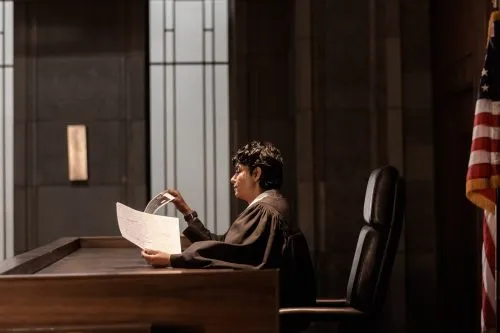
If you are represented, a lawyer will tell you whether your appearance is in person or virtual. If it is virtual, we recommend that: Before the Hearing and Attire Traditional business attire is recommended Litigants check and familiarize themselves with their software before the hearing Zoom link should be available on Case Center, which your lawyer will forward to you Dial in at least 10 minutes in advance of the hearing, where you will wait in a virtual "waiting room" Do not record any of the hearing, or take any screenshots Virtual Courtroom Etiquette Find an appropriate place to conduct the hearing - Join from a quiet area, where there are no others. Ensure that there are no children present who can overhear the court appearance Your screen name should be your given name and your surname (All participants at the hearing can see your display name) If possible, use earphones that have a built-in microphone Mute yourself when you are not speaking. This reduces echo and background noise Do not eat during the hearing Do not walk away from your screen or put your feet up on the table/chair During the video conference, mute notifications on your computer/device If...

Family law disputes make up a significant portion of the Court's work in Ontario. Some of the issues addressed in family court in Ontario are; Decision making of child(ren) Parenting time of child(ren) Child support Spousal support Division of property In 50% of the province, family law issues are divided between the Superior Court of Justice and the Ontario Court of Justice. The Ontario Court of Justice cannot preside over divorces or property disputes. Only the Superior Court of Justice can deal with those issues. Whereas, cases dealing with child protection and adoption must be started at the Ontario Court of Justice. Aside from this, both Courts can hear decision making, parenting time, and support issues. In the other 50% of Ontario, there are Family Court Branches of the Superior Court. These Courts are often referred to as the Unified Family Court (or the UFC). UFCs can hear any family law issue. There are a core group of specialized judges at the UFC. The Family Law Rules govern the processes in the family court. The Family Rules Committee was created under the Courts of Justice Act. This Committee is responsible for amendments to the Rules, which is subject to the...

Regions and Regional Senior Judge (RSJ) The Ontario Superior Court of Justice sits in 52 locations in Ontario. As of December 31, 2023, it had 341 federally appointed judges and 15 provincially appointed associate judges. There are eight administrative regions of the Ontario Superior Court of Justice: Central East Central South Central West East Northeast Northwest Southwest Toronto Each region is headed by a Regional Senior Judge. Section 14(2) of the Courts of Justice Act provides them with their authority in this role, including managing judicial sittings. The Chief Justice leads the Ontario Superior Court of Justice. They oversee the governance of the Court and its administration. Their responsibilities are found in Ontario's Courts of Justice Act. For example, they determining the sittings. In total, 11 judges comprise the Council of Regional Senior Judges and advise the Chief Justice on policy affecting the Court's administration. These judges include: Associate Chief Justice Eight Regional Senior Judges Senior Judge of the Family Court Jurisdiction The Ontario Superior Court of Justice is a court of inherent jurisdiction. This means that was not created because of legislation. Its history is rooted in the first courts in England. The Ontario Superior Court of Justice has jurisdiction...

The following is a list of things we encourage litigants to keep in mind prior to a Zoom court appearance. This list is for guidance only and is not exhaustive. The directions of the presiding judge should always be followed. A litigant's role - Your lawyer, if any, will speak with the judge on your behalf. Please remain silent throughout the proceeding unless the judge or your lawyer speaks to you. If you address a judge in the Superior Court of Justice, call the judge “Your Honour”, “Mister/Madam Justice (last name)”. If you are called to speak, speak slowly and clearly. Be sure to say your name before you start speaking. While speaking, look into your camera lens. This gives the other participants direct eye contact with you. Do not look at the person to whom you are speaking. Communicating with your lawyer - If you need to tell you lawyer something while court is in session, e-mail your comment(s) to them. Please do not try and get their attention as this is distracting to the judge. Setting - Find an appropriate space to conduct the video conference. Do your best to participate from a private, quiet space. Find a...

Family law cases in the Ontario Superior Court of Justice (Family Branch), the Ontario Superior Court of Justice, and the Ontario Court of Justice are governed by the Family Law Rules (Family Law Rules, Rule 1(2)). Rule 2(2) of the Family Law Rules outlines that the primary objective of these Rules is to "enable the court to deal with cases justly." Dealing with a case justly includes: Ensuring that the procedure is fair to all of the parties; Saving expense and time; Dealing with the case in ways appropriate to its importance and complexity; and, Giving appropriate court resources to the case while taking account of the need to offer resources to other cases. Rule 2 continues that judges must "promote the primary objective by active management of cases," including helping parties identify the issues, encouraging alternative dispute resolution, helping parties to settle, setting timetables, and controlling the progress of a case. Under the Family Law Rules, cases are started by an Application if there has never been an order made on the issues before the court. If a previous court order has been made on the issues before the court, they are started by Notice of Motion to Vary. According...

A person starting an Ontario family law case files a document called an Application. The person in an Ontario family law case who is making the claim is, therefore, referred to as the Applicant. An Application in an Ontario family law case may contain a claim against more than one person and more than one claim against the same person. The Applicant in an Ontario family law case seeks relief from the court by checking off one or more boxes under the applicable legislation. The form requires the Applicant to set out the grounds for his/her claim(s). The Application in an Ontario family law case must be served on every other party by "special service" unless otherwise provided. Special service is carried out by: Leaving a copy with the opposing party, who is called the Respondent; Note: If the person is or appears to be mentally incapable in respect of an issue in the case, then one can leave a copy with the person and with the guardian of the person’s property or, if none, with the Public Guardian and Trustee. If the person is a child, then one can leave a copy with the child and with the child’s lawyer, if any. If the person...

The key steps in a typical matrimonial lawsuit under the Family Law Rules are: the application, answer, case conference(s), motion(s), settlement conference, trial management conference, trial, and appeal. In Ontario, three courts deal with family law matters: The Family Court branch of the Superior Court of Justice; The Superior Court of Justice; and, The Ontario Court of Justice. The Family Court of the Superior Court of Justice (also called the Superior Court of Justice or Family Court) is a specialized court dealing with all aspects of family law. These courts are located throughout Canada and provide specialized judges. In areas of Ontario that do not have a Family Law Court of the Superior Court of Justice, the Superior Court of Justice is the court of superior jurisdiction. In the realm of family law, this court deals with the following issues: property, divorce, custody, access, and support. The Ontario Court of Justice deals with custody, access, support, child protection, and adoption. This court does not deal with divorce or property issues.
When an Application is filed in the Superior Court of Justice or the Family Court of the Superior Court of Justice, whether a court date is set depends on whether the case is standard track or fast track. Applications that contain a claim for divorce or property are standard track, whereas all other cases are fast track. In a case that is standard track, the court clerk does not automatically set a court date when the Application is filed. The Applicant generally waits until the Respondent has been served with an Application and until after he or she has filed an Answer before booking the next step (being a case conference). Generally, an Applicant may obtain a case conference date when the Application is filed by serving and filing a Conference Notice (Form 17). In the Ontario Court of Justice, the first court date or the First Appearance Court (FAC) is always held before a court clerk who, among other duties: Confirms that all of the required documentation have, in fact, been served and filed; If an Answer has been filed, confirms that the case is ready for a hearing, case conference, or settlement conference and thereafter schedules it; and, If an Answer has not been filed,...
Where the Family Court branch of the Superior Court of Justice operates, there is no divided jurisdiction in those family law matters. This is so because the Family Court branch of the Superior Court of Justice exercises a single jurisdiction over all legal disputes in family law. Given that this is a unified family court, it allows family law litigation to be dealt with in an integrated manner. In Ontario, where the Family Court branch of the Superior Court of Justice does not exist, the jurisdiction over family law matters is divided between the Superior Court of Justice and the Ontario Court of Justice. Cases that involve divorce and/or property claims can only be brought before the Superior Court, whereas child protection and adoption cases must be commenced only in the Ontario Court of Justice. Each of these two courts has jurisdiction to adjudicate over issues of child and support, as well as claims for custody and access.

The continuing record has all of the documents filed with the court in a case. The continuing record is composed of two volumes: an endorsements volume and a documents volume. The endorsements volume contains a cumulative table of contents, the endorsements in the matter, and the orders in the matter. The documents volume contains all of the documents filed in the case. There are different continuing records for support enforcement cases, child protection cases, and status review hearings. Parties can no longer simply elect to have separate records for each party. Currently, in cases other than enforcement cases, child protection cases, and status review hearings, in order to have separate records for each party, a court order to this effect is required (Family Law Rules, Rule 9(7)). If the continuing record has not been separated, the parties are jointly responsible for adding to the record under the court clerk's supervision. In the case of separated records, each party is responsible, under the clerk's supervision, for adding the documents the party files to the party's own record (Family Law Rules, Rule 9(11)). No party shall serve or file any document that is already in the record, despite any requirement in the Family Law Rules that the document be...