

Table of Contents
Your common-law relationship is ending after seven years together. You’ve built a life – maybe bought property, raised children, shared finances. Now friends tell you that because you weren’t married, you have no rights to anything. Others insist common-law couples have the same protections as married spouses after living together for a certain time. The confusion leaves you paralyzed, unsure whether you’re about to lose everything or if you’re protected by laws you don’t understand. For many Ontario couples, this uncertainty is exactly why a common law separation agreement becomes one of the most important legal tools at the end of a relationship.
I know this confusion because Ontario’s treatment of common-law relationships differs dramatically from married couples – and those differences catch people off guard when relationships end. The property you assumed you’d split fairly? You might have no automatic claim to it. The support you thought you’d receive? You might not qualify. Meanwhile, your children’s needs remain the same regardless of your marital status, and the decisions you make now will affect your financial security for years. A properly structured common law separation agreement helps clarify those decisions before conflict escalates.
Here’s what you actually need to know about common law separation agreements in Ontario – the real differences between your rights and those of married couples, when you qualify for spousal support, how property gets divided (or doesn’t), and why a properly drafted separation agreement protects both of you from expensive court battles that exploit these legal gaps.
The Critical Differences Between Common Law and Married Couples in Ontario

Ontario law treats common-law and married couples very differently when relationships end. Understanding these differences prevents costly surprises.
What Common Law Couples Don’t Get Automatically
- Property equalization: The Family Law Act’s property division rules don’t apply to common-law relationships. If your partner owns the house solely in their name, you typically have no automatic claim to half its value.
- Immediate spousal support eligibility: Married spouses can claim support immediately. Common-law partners generally need three years of cohabitation, or a child together with a relationship of some permanence, to qualify under the Family Law Act.
- Matrimonial home protections: Married spouses both have rights to stay in the matrimonial home regardless of title. Common-law partners not on title may have no right to remain.
- Presumption of sharing: Property belongs to whoever holds legal title unless you can prove otherwise through claims like constructive trust or unjust enrichment.
What Common Law Couples Do Have Rights To
- Child support and parenting: Your relationship status makes no difference. Both parents have equal obligations to support children and equal parenting rights.
- Spousal support if eligible: Once you meet the three-year threshold or have a child together, support is calculated using the same Spousal Support Advisory Guidelines as married couples.
- Property claims through legal arguments: You can make claims based on constructive trust, unjust enrichment, or joint family venture – though these require proving specific facts and often involve litigation.
These differences make a common law separation agreement even more critical than for married couples. Because Ontario law does not provide automatic protections for unmarried partners, a common law separation agreement often becomes the only reliable way to define property, support, and financial obligations.
Understanding Property Rights When Common Law Relationships End
The biggest shock for many common-law couples is discovering that property division works completely differently than they assumed. A common law separation agreement allows couples to bypass these default rules and set their own terms for property division.
No Automatic Property Equalization
Married couples benefit from the Family Law Act’s equalization provisions, which treat marriage as an economic partnership. Common-law couples get none of this. If your partner’s name is the only one on the house deed, the car ownership, the investment accounts – those assets legally belong to them. The length of your relationship doesn’t change this.
Making Property Claims Without Automatic Rights
Ontario courts recognize several legal concepts that can give you a claim to property even without being on title:
Constructive Trust: If you can prove you contributed to acquiring or maintaining property that your partner owns, and it would be unjust for them to keep all of it, a court may find they hold some of that property in trust for you.
Unjust Enrichment: This requires proving your partner benefited from your contributions, you suffered a corresponding loss, and there’s no legal reason justifying this benefit.
Joint Family Venture: Courts sometimes find common-law couples operated as a joint family venture – pooling resources, making joint decisions, working toward common goals – which can support property claims.
The Reality of Property Disputes
These claims require litigation. You’ll need to prove your contributions, document the benefit to your partner, and convince a court that fairness demands compensation. These cases routinely cost $50,000 to $150,000 or more in legal fees.
Resolving these issues through a common law separation agreement is almost always faster, more predictable, and significantly less expensive than litigation. By deciding together how to divide property, you eliminate the need to prove unjust enrichment or constructive trust. You create certainty about who keeps what – all without the cost and stress of litigation.
Joint Ownership Simplifies Some Issues
If you and your partner jointly own property, this already provides some protection. Joint ownership typically means you each own 50% regardless of who paid more. However, even jointly owned property needs clear terms in your separation agreement about disposition.
Spousal Support Rights for Common Law Partners in Ontario
Spousal support is one area where common-law couples can have the same rights as married couples – but only if they meet specific eligibility requirements first.
The Three-Year Rule and Other Paths to Eligibility
Under Ontario’s Family Law Act, you’re eligible to claim spousal support from a common-law partner if:
- You lived together continuously for at least three years, or
- You have a child together and have been in a relationship of some permanence
The three-year requirement is firm. If you lived together for two years and eleven months with no children, you generally cannot claim spousal support under the Family Law Act. This differs dramatically from married couples, where even a short marriage creates potential support obligations.
The “relationship of some permanence” with a child is less defined. Courts look at factors like how long you lived together, whether you presented yourselves as a couple, how integrated your lives became, and whether you made decisions together about raising your child. A one-year relationship where you lived together, had a child, and functioned as a family unit might qualify. A brief relationship that happened to produce a child likely won’t.
How Support Gets Calculated Once You Qualify
Here’s where common-law couples who meet the eligibility threshold get treated the same as married couples. The Spousal Support Advisory Guidelines (SSAG) – the formulas Ontario courts use to calculate support amounts – apply equally regardless of whether you were married or common-law.
The SSAG considers:
- Income difference: The greater the gap between your incomes, the higher the potential support amount
- Length of cohabitation: Longer relationships typically mean longer support durations
- Parenting arrangements: If you have children, the with-child formula applies, which typically results in lower amounts than the without-child formula
- Ages and circumstances: Factors like health issues, care responsibilities, and career sacrifices affect both amount and duration
The SSAG produces a range, not a fixed number. Your separation agreement can set support anywhere within that range (or outside it, if both parties agree) based on your specific circumstances.
Duration Considerations
Support duration for common-law couples follows similar principles to married couples, but the length of cohabitation heavily influences how long support continues. The SSAG typically suggests support duration between half the length of cohabitation (at the low end) to the full length of cohabitation (at the high end).
For example, if you lived together for six years, support might last anywhere from three to six years. Longer relationships, especially those where one partner made significant career sacrifices, can result in indefinite support – meaning support with no fixed end date, though it can still be reviewed and changed based on circumstances.
Including Support Terms in Your Agreement
A common law separation agreement should clearly document how spousal support is handled, especially given the strict eligibility thresholds that apply to unmarried couples in Ontario. It should include, for example:
- Whether support will be paid, by whom, and in what amount
- The duration of support obligations
- Whether support is reviewable or non-reviewable
- How support might change based on income changes or other circumstances
- Whether you’re waiving the right to claim support in the future
That last point matters particularly for common-law couples. If you don’t currently qualify for support under the three-year rule but might soon, or if you qualify but choose not to receive support now, your agreement should clearly state whether you’re preserving or waiving future support claims.
Why Common Law Couples Need Separation Agreements
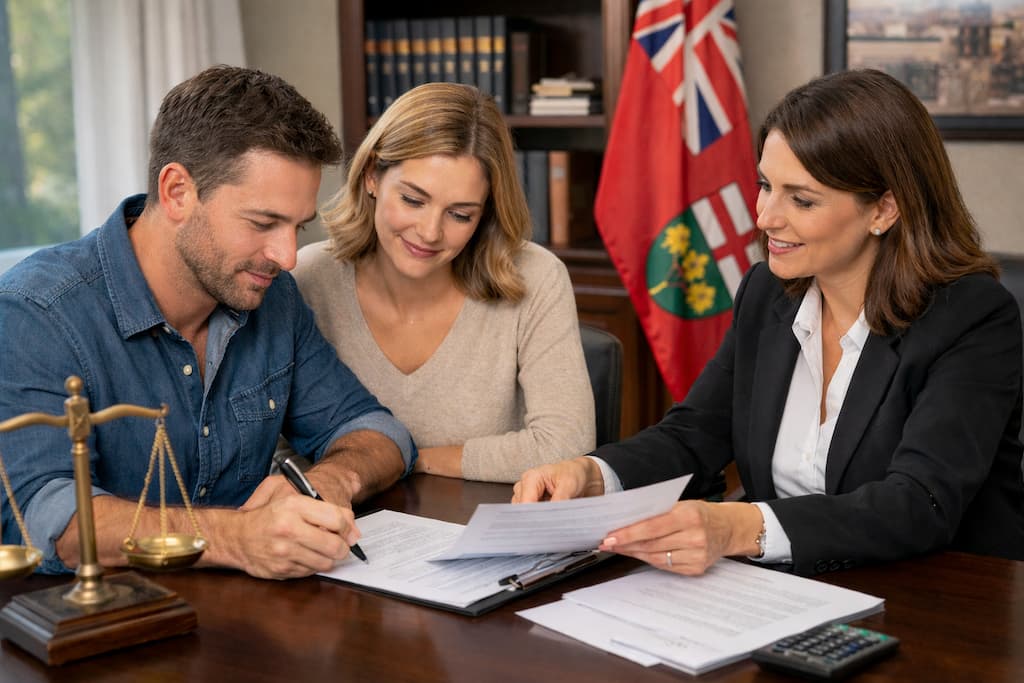
The gaps in automatic legal coverage make written agreements critical for avoiding expensive disputes.
Preventing Expensive Property Litigation
Without automatic property division rules, disagreements about who owns what often end up in court. These cases routinely cost $50,000 to $150,000 or more in legal fees – often more than the property in dispute.
A common law separation agreement stops these disputes before they start. By deciding together how to divide property, you eliminate the need to litigate unjust enrichment claims and prove your contributions through expensive court proceedings.
Creating Clarity About Support Obligations
Even couples who meet the three-year eligibility threshold for spousal support face uncertainty about amounts, duration, and changed circumstances. Your separation agreement lets you control these decisions based on your actual situation rather than leaving them to a judge.
Protecting Both Parties From Uncertainty
A well-drafted separation agreement protects both of you:
- For the partner with fewer assets: Establishes property rights you wouldn’t automatically have and secures support you might struggle to prove you deserve
- For the partner with more assets: Prevents future claims based on constructive trust or unjust enrichment and eliminates the risk of expensive litigation
- For couples with children: Establishes the framework for parenting arrangements and child support while demonstrating careful consideration of children’s needs
- For both parties: Provides a clear roadmap for moving forward and typically costs a fraction of what litigation would cost
The Cost-Benefit Reality
Having a lawyer help you negotiate and draft a separation agreement typically costs between $2,000 and $7,000. Litigating property division, support, and parenting issues typically costs $30,000 to $100,000 or more. For common-law couples without automatic legal protections, reaching an agreement makes even more financial sense.
What Your Common Law Separation Agreement Should Include
A well-drafted common law separation agreement anticipates future disputes and resolves them before they arise. A comprehensive separation agreement addresses every significant issue that could cause disputes later.
Property Division Terms
- Real estate: Who keeps the home? How much will they pay the other? If selling, how will proceeds be divided? Address cottages, rental properties, and other real estate.
- Vehicles and accounts: Specify who keeps each vehicle, and how you’re dividing bank accounts, RRSPs, TFSAs, and investment accounts.
- Business interests: Address business ownership and whether one partner receives compensation for contributions to building the business.
- Personal property: For high-value items like furniture, electronics, artwork, and jewelry, specify who gets what.
- Pensions: Address whether any pension sharing is occurring and how this will be handled.
Debt Allocation
- Joint debts: Specify who will pay what portion of jointly held debts and by when. Include provisions for missed payments.
- Individual debts: Confirm each person remains responsible for debts in their own name only.
- Indemnification: Include provisions protecting each party from liability for debts the other promised to pay.
Spousal Support Provisions
If spousal support is part of your agreement, include amount and frequency, duration, tax treatment, review provisions, and termination events.
If you’re waiving spousal support, include clear language stating you’ve both received independent legal advice and understand you’re giving up the right to claim support in the future.
Child-Related Provisions
- Primary residence and schedule: Where will children primarily live, and what is the regular parenting time schedule including holidays and vacations?
- Decision-making: How will you make important decisions about education, healthcare, religious upbringing, and extracurricular activities?
- Child support: What is the monthly child support amount based on the Federal Child Support Guidelines?
- Section 7 expenses: How will you share costs for childcare, healthcare, extracurricular activities, and post-secondary education?
- Income disclosure: Include provisions requiring annual income information exchange to ensure child support remains appropriate.
Additional Important Clauses
- Confirmation that both parties received independent legal advice
- Confirmation of complete financial disclosure
- Clear language about what future claims you’re each waiving or reserving
- Dispute resolution procedures
- Modification provisions (noting child-related terms are always modifiable based on best interests)
Why Professional Drafting Matters
Having a family lawyer draft or review your agreement ensures it’s legally enforceable, covers all necessary issues, protects your interests, and complies with current Ontario family law. For common-law couples without automatic legal protections, professional legal advice becomes even more important.
Protecting Your Interests When Your Common Law Relationship Ends

Common-law couples in Ontario face a more uncertain legal situation than married spouses when relationships end. Without automatic property division rights or guaranteed spousal support eligibility, the protection you need comes from a well-drafted common law separation agreement rather than assumptions about what the law provides.
A common law separation agreement creates the certainty both parties need about property, support, and parenting obligations. It eliminates the risk of expensive litigation over constructive trust claims, unjust enrichment, and whether you qualify for support. Most importantly, it lets you control decisions about your financial future rather than leaving those decisions to a judge who doesn’t know your relationship or your circumstances.
If you’re ending a common-law relationship in Ontario, getting legal advice before signing a common law separation agreement can protect your financial future and prevent costly mistakes. The differences between your rights and those of married couples make professional guidance critical to protecting your interests and avoiding costly mistakes.
Common Law Separation Agreement FAQs
What is a common law separation agreement in Ontario?
A common law separation agreement is a written contract that sets out how unmarried partners will resolve property division, spousal support, parenting arrangements, and financial obligations when their relationship ends.
Is a common law separation agreement legally binding in Ontario?
Yes. A common law separation agreement is legally enforceable if both parties provide full financial disclosure, receive independent legal advice, and sign the agreement voluntarily without pressure or coercion.
Do I need a common law separation agreement if we agree on everything?
Yes. Even when both partners agree, a common law separation agreement documents those terms in a legally enforceable way and protects both parties from future disputes or unexpected claims.
Can a common law separation agreement deal with property division?
Yes. Because Ontario law does not provide automatic property equalization for common-law couples, a common law separation agreement is often the only way to fairly divide property without litigation.
Does a common law separation agreement cover spousal support?
It can. A common law separation agreement can establish spousal support amounts, duration, review terms, or include a valid waiver of future support claims, depending on eligibility and circumstances.
Can a common law separation agreement be changed later?
A common law separation agreement can be amended if both parties agree in writing. Child-related terms may also be modified later if circumstances change and it is in the child’s best interests.